Written by Daylogue Editorial Team. Published August 21, 2026. Reviewed and updated August 21, 2026.
Big Five facets are narrower traits grouped beneath the five broad domains. They help explain why two people with similar domain scores can answer differently across item themes. A facet result should be read with the instrument, item count, scoring key, and reference group. It adds descriptive detail, but it does not reveal a hidden essence or settle how someone will act in every setting.
The difference between a domain and a facet
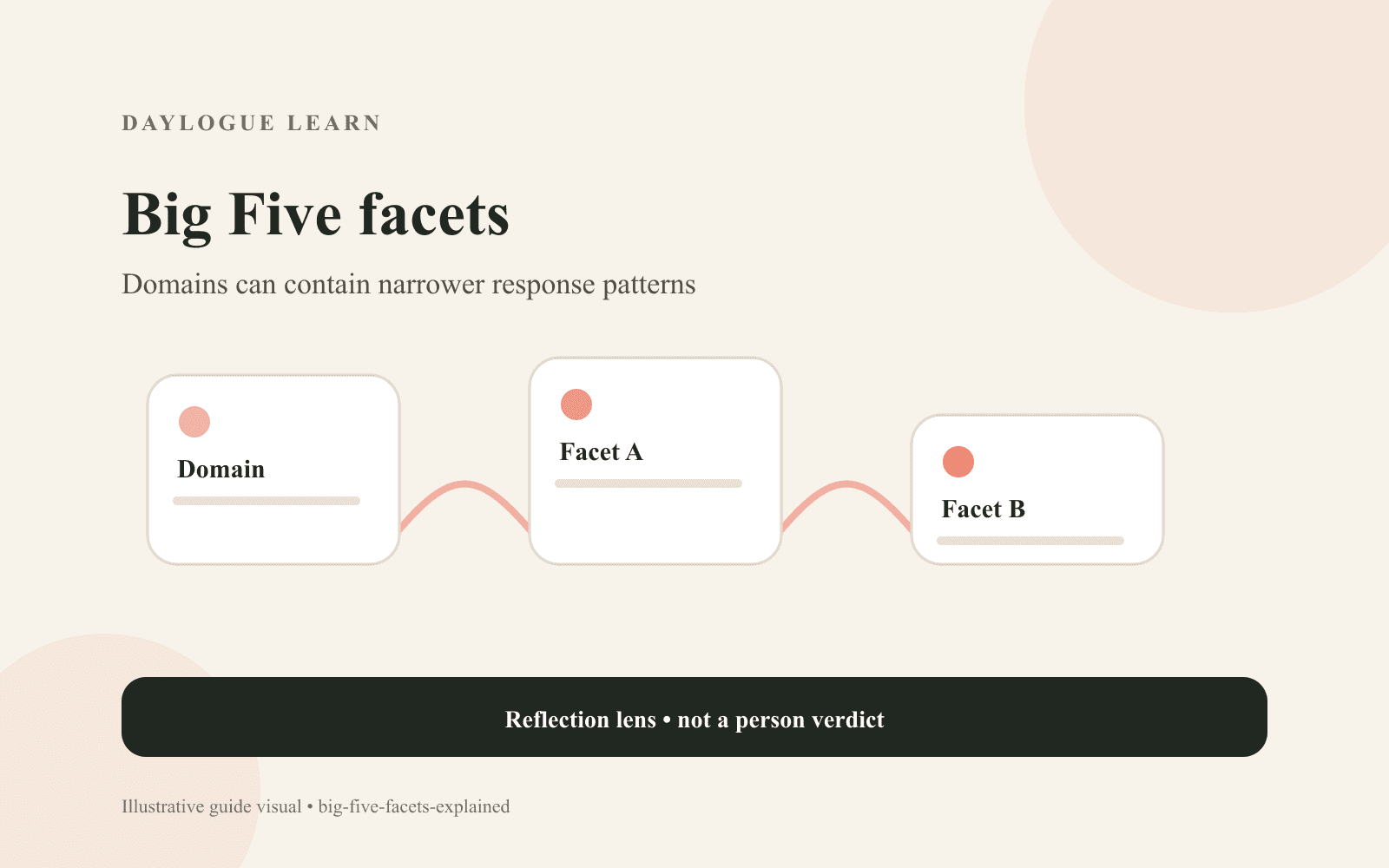
A domain is a broad summary such as extraversion or conscientiousness. A facet is a narrower response pattern nested within that domain. Think of the domain as a wide map and facets as named areas inside it. The broad score answers where the combined item responses landed. Facets help show which parts of that combined pattern rose, fell, or stayed nearer the middle.
Facets do not replace the domain. They explain some of its internal shape. If sociability and assertiveness move in different directions, a single extraversion total may sit near the middle even though neither facet feels especially moderate. That is not a contradiction. It is what averaging narrower responses into a broader result can do.
How one established inventory structures the detail
The BFI-2 is a 60-item self-report inventory designed to measure five broad dimensions and 15 more-specific facet traits. That means each broad dimension has narrower components in the instrument’s design. The facet structure is part of the named measure, not a set of labels that should be guessed after seeing a domain total.
Before interpreting facets, confirm which questionnaire produced them. Another Big Five instrument may use different facet names, different items, or a different number of narrower scales. Similar language does not guarantee identical construction. Keep the report attached to its instrument, version, scoring instructions, and item source.
| Level | What it summarizes | Careful question |
|---|---|---|
| Broad domain | Responses across a wide trait dimension | Which general direction did the combined answers take? |
| Facet | Responses to a narrower item theme | Which part contributed most to the broad pattern? |
| Single item | One statement and one response | Did the wording fit how I understood myself? |
| Real example | Behavior in a specific context | Where does the reported description fit or bend? |
Why facets within one domain can diverge
A person can enjoy group conversation yet hesitate to take charge. Another can speak assertively in a technical setting while preferring little social stimulation afterward. If an instrument places sociability and assertiveness beneath the same broad domain, those scenes can produce an uneven facet profile. The total compresses both into one overview.
Uneven facets are not a puzzle that must be solved into a new type. They are a reminder to read the item themes and the lived context. Ask which roles make one response easier, which demands make another costly, and whether the test wording matched the settings you had in mind while answering.
A middle domain score may contain strong differences
A middle domain result does not require every facet to be near the midpoint. Higher responses on one narrower theme and lower responses on another can average together. The domain still reports the combined pattern correctly according to its scoring rules, while the facets preserve distinctions that the total cannot display on its own.
A broad result cannot supply facet scores that the questionnaire did not report. If the questionnaire did not measure or report facets, the information is not there. You can still use examples and counterexamples for reflection, but call them scenes or questions, not unofficial facet results. Precision in language matters as much as precision in scoring.
Facet interpretation starts with the items
Read several items associated with the facet before accepting its label at face value. Notice response direction, reversed wording, time frame, and whether statements describe preference, frequency, or intensity. A familiar label can sound broader than the specific item set that created the result.
The IPIP website includes over 3,000 items and over 250 scales, and its items and scales are in the public domain. That breadth makes the instrument name and exact scale especially important. “An IPIP test” is not enough information because many different item sets and scales can be assembled from the pool.
Use examples and counterexamples at the facet level
Choose one recent example for the facet description and one scene that goes the other way. For order, you might compare a carefully maintained client folder with an improvised home workspace. For assertiveness, compare a meeting where you challenged a proposal with a family conversation where you stayed quiet. The setting often explains more than the adjective.
Keep the counterexample beside the example. A facet is a descriptive summary, not a rule that every scene must obey. Record the role, stakes, people present, available time, and what changed from usual. Those details let you ask why the tendency appeared without pretending the facet score supplied the answer.
- Name the exact facet and instrument.
- Copy the report’s plain-language definition.
- Find one recent example that fits.
- Find one recent counterexample.
- Describe the settings around both scenes.
- Note any item wording that felt ambiguous.
- Keep the conclusion open to another example.
More detail is not automatically more certainty
A facet report can feel precise because it contains more numbers. Precision of display is not the same as certainty about a person. Narrower scales may use fewer items than broad domains, so check what the instrument reports about construction and interpretation. Use the extra detail to ask better questions, not to issue a more elaborate verdict.
A 2025 reliability meta-analysis included 57 study datapoints from 34 research articles and compared the BFI and BFI-2 across languages and cultures. That source addresses internal consistency across collected studies. It does not make every informal web quiz equivalent to a named inventory, and it does not turn an individual facet result into a prediction.
A practical facet reflection method
Begin with the broad domain, then identify the facet that seems most different from the total. Read its item theme. Write one example and one counterexample with dates. Add the setting and what mattered in each scene. End with a question about when the narrower tendency becomes more or less visible.
Revisit the question after another real event rather than retaking the test immediately. Daily observations can give the facet language context, but they should not be converted into unofficial scores. The value is a clearer record of where a description fits, where it bends, and what remains uncertain.
01
Name the source
Record the instrument, version, date, item count, and any reference information shown in the report.
02
Read the facet definition
Use the instrument’s own wording and inspect representative items before substituting a casual synonym.
03
Pair two scenes
Write one example and one counterexample with the role, stakes, setting, and sequence preserved.
04
Ask a contextual question
Look for conditions that may shape the response without claiming that the score proves a cause.
Careful reading notes
Facets are useful because the same domain total can be assembled from different narrower responses. One openness result might reflect stronger interest in ideas than in aesthetic experience. Another might reach a similar total through a different pattern. The facet labels and groupings belong to the named instrument, so read its scoring notes before borrowing a subscale name from another questionnaire. The narrower view adds questions to inspect. It does not create a more definitive verdict about the respondent.
A practical facet review starts with the actual item groups. Mark which narrower scores sit close together and which separate. Then find one ordinary scene for each side of the spread, including a situation that does not fit. This keeps the broad domain, the instrument’s facet structure, and lived examples in the same frame. When only an overall score is available, the report cannot supply the missing facet results.
Worksheet
Domain and facet interpretation worksheet
A structured way to keep the named instrument, broad result, narrower facet, item wording, examples, counterexamples, and open questions together.
- Instrument and version
- Broad domain result
- Facet name used by the instrument
- Facet item theme
- One example that fits
- One counterexample
- Context around each scene
- Ambiguous item wording
- Difference between facet and domain
- Question to revisit
Common questions
How many facets are in the BFI-2?
The Berkeley Personality Lab describes the BFI-2 as measuring five broad dimensions and 15 more-specific facets. Other Big Five instruments may organize narrower traits differently, so keep the number attached to the named inventory.
Can two facets under one domain point in different directions?
Yes. Narrower item themes can produce different response patterns. Their combination may yield a middle broad score or a total that hides an uneven profile. Read both levels without turning the mix into a type.
Is a facet more accurate than a domain?
It answers a narrower question. That can add useful detail, but it does not automatically make the result more certain. Check item count, construction, scoring, and the purpose of the instrument.
Can I infer facets from my broad score?
No. When the instrument did not measure or report facets, the total cannot supply those missing results. You can write examples and questions about narrower behaviors without calling those reflections facet scores.
How can I reflect on a facet safely?
Keep the instrument and item wording visible, then pair one real example with one counterexample. Add context and end with a provisional question rather than an identity statement.
Sources
Sources were checked on the dates shown. Product details and policies can change.
- Berkeley Personality Lab: Big Five Inventory 2 · Berkeley Personality Lab · checked August 21, 2026
- Big Five Inventory reliability generalization meta-analysis · National Library of Medicine · checked August 21, 2026
- International Personality Item Pool · Oregon Research Institute · checked August 21, 2026
Keep exploring
Big Five personality test guide
Start with the Big Five model, its five domains, scoring basics, and limits.
Read morePersonality tests for self-awareness
Compare assessment frameworks without treating a result as a person verdict.
Read moreDaylogue Reflection Profile
Try Daylogue’s non-clinical self-awareness quiz and keep its result in context.
Read moreDaylogue is not therapy and is not a replacement for professional care.