Written by Daylogue Editorial Team. Published August 21, 2026. Reviewed and updated August 21, 2026.
An openness score describes how answers landed on one Big Five spectrum associated with curiosity, imagination, interest in ideas, and comfort with novelty. The instrument, reference group, facets, and response context belong beside the number. A concrete example and counterexample can show where the description fits and where it bends without turning the result into a fixed identity.
What an openness score means
An openness score summarizes how a set of questionnaire answers lines up along a Big Five dimension associated with curiosity, imagination, interest in ideas, and comfort with novelty. The raw total or percentile belongs to a named instrument and scoring method. It describes the response pattern produced in that test setting. It does not establish a permanent essence, a grade, or the best way to act in every situation.
The first interpretation question is comparative: compared with whom, using which items, under what scoring rules? A percentile places answers relative to a reference group. A raw score reflects the keyed responses on that particular form. Neither tells the whole story until you know the instrument, its range, and the sample used to create the reported comparison.
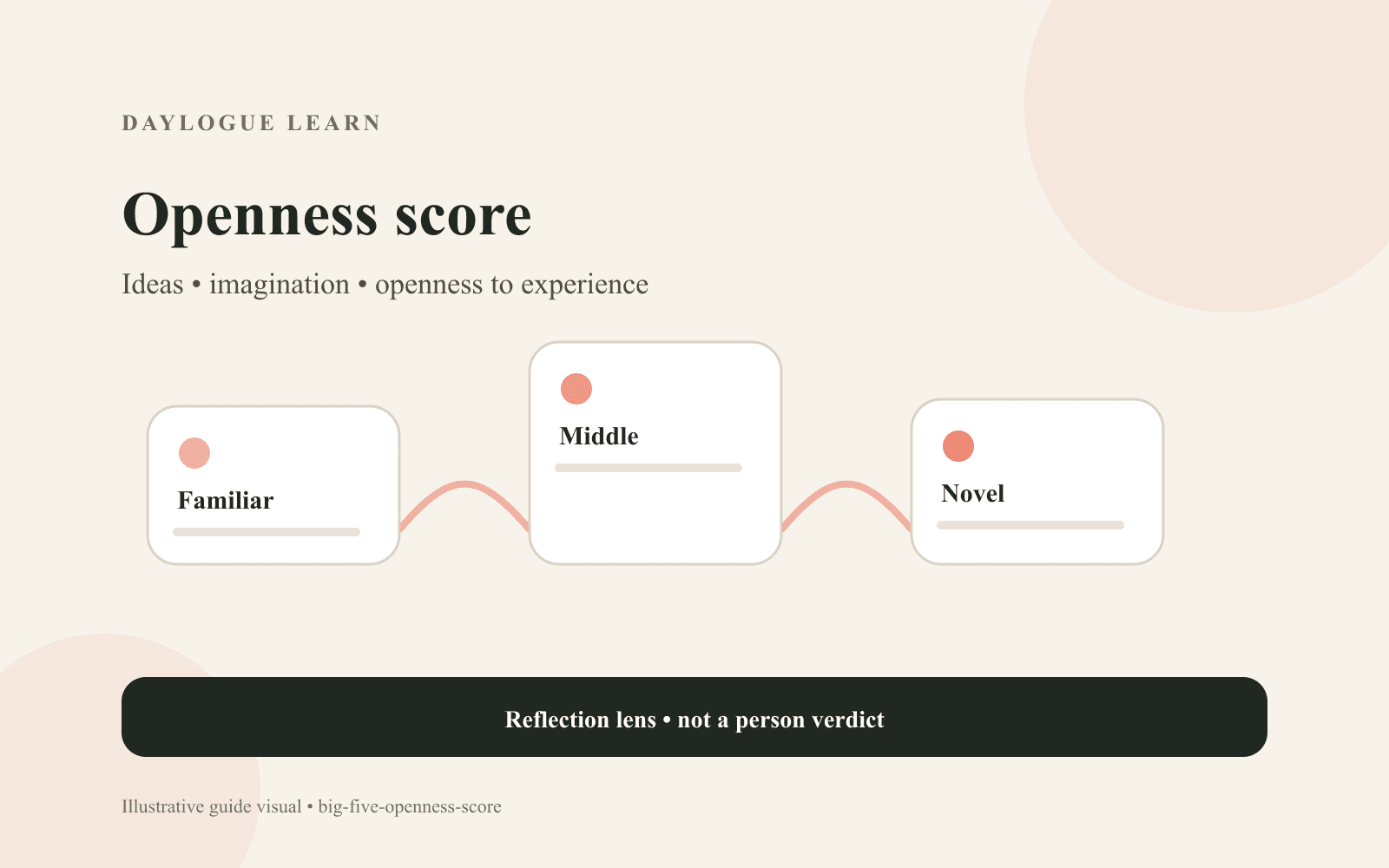
Read lower, middle, and higher as positions
A lower result may reflect answers favoring familiarity, practical continuity, or established methods in the situations the items describe. A middle result can reflect a mix: enthusiasm for novelty in one area and preference for known routines in another. A higher result may reflect answers favoring exploration, imagination, or engagement with unfamiliar ideas and experiences. These descriptions are tendencies in answers, not character categories. Every position can be useful in one context and costly in another, depending on the task, relationship, resources, and stakes.
Avoid converting the spectrum into two opposing types. A person near one end can still show behavior associated with the other end. A middle score is not blank or indecisive. It may reflect moderate endorsement, balanced item responses, or sharp differences among narrower facets that average into the middle.
| Reported position | Careful interpretation | Question to ask |
|---|---|---|
| Lower | A lower result may reflect answers favoring familiarity, practical continuity, or established methods in the situations the items describe. | Where does the opposite behavior appear? |
| Middle | A middle result can reflect a mix: enthusiasm for novelty in one area and preference for known routines in another. | Which situations pull the response apart? |
| Higher | A higher result may reflect answers favoring exploration, imagination, or engagement with unfamiliar ideas and experiences. | When is this tendency less visible? |
Put the result beside one real scene
A score becomes more useful when you translate it back into scenes. Consider this one: You eagerly test a new design tool at work, yet order the same meal before a demanding trip because familiarity feels useful. Both details belong in the interpretation. One may fit the reported direction while the other supplies a counterexample that keeps the result from hardening into a label.
Write the event in sequence. What happened first? What choice did you make? What changed from the usual setting? Which part of the score description seems to fit, and which part misses? This method gives the result an inspectable anchor without asking one memory to prove a lifelong tendency.
Look beneath the broad domain
A broad openness result can hide different responses to abstract ideas, creative activity, aesthetics, and everyday novelty. This is why two people with similar broad results can recognize themselves in different parts of the item set. The total compresses those narrower response patterns into one dimension, which is useful for overview and incomplete for explanation.
If a report provides facets, read each as another descriptive result rather than as a hidden truth. Check which items belong to each facet, whether enough items support that detail, and whether the facet language matches the instrument. When a short test reports no facets, the broad score cannot supply that missing detail.
Keep examples and counterexamples together
An example shows where the description fits. A counterexample shows where it bends. Keep both in the same note. Reading a lower result as uncreative, or a higher result as automatically wiser, turns a descriptive dimension into a value judgment. A counterexample restores scale by showing that the tendency has conditions, limits, or exceptions.
Strong counterexamples are specific. Name the role, people present, stakes, available time, and what happened next. “I am sometimes different” is too broad to teach much. A dated scene makes the contrast available for later comparison and reduces the temptation to explain every action through one trait word.
- Where do I actively seek novelty?
- Which familiar routines make exploration easier?
- When do I enjoy abstract ideas but avoid practical change?
- What recent counterexample complicates this result?
- Did the questionnaire emphasize art, ideas, or novelty more than the parts that fit me?
- Which setting makes the opposite tendency visible?
Common interpretation mistakes
The most common mistake is turning “higher” into “more” in every setting and then reading more as better. Another is reading a middle result as meaningless. A third is applying one domain to unrelated qualities, such as using openness to infer intelligence, morality, compatibility, or future success. The score does not carry those conclusions.
Retesting immediately can also create confusion. If two results differ, inspect item count, wording, response scale, scoring key, norms, language, setting, and timing before choosing a favorite. Different instruments can use the same trait name while measuring it with different items and reference information.
A five-step interpretation routine
Use the score to generate questions that can meet real life. Begin with the instrument and reference group. Translate the reported position into plain language. Find one recent example and one counterexample. Add the context around each. Then write a provisional sentence that can change when new evidence appears.
A careful provisional sentence sounds like this: “On this questionnaire, my openness answers landed in this range, and I notice the description fits more in these situations than in those.” The sentence preserves the result while keeping authorship and uncertainty with the person reading it.
01
Name the instrument
Record the questionnaire version, item count, date, response scale, and any reference group shown in the report.
02
Translate the result
Describe the openness result in ordinary words without turning the reported range into a type or grade.
03
Find an example
Choose one recent scene where the description fits and write the observable details around it.
04
Find a counterexample
Choose one scene where another response appeared and preserve the conditions that were different.
05
Keep the conclusion provisional
End with a question that another week, setting, or person’s perspective could help clarify.
What the sources establish
The BFI-2 is a 60-item self-report inventory designed to measure five broad dimensions and 15 more-specific facet traits. That design shows why broad domains and narrower facets should not be read as interchangeable. A total score provides an overview, while the item and facet structure supplies the detail needed to understand how the total was formed.
The IPIP website includes over 3,000 items and over 250 scales, and its items and scales are in the public domain. The Daylogue Big Five guide explains that scores fall on spectrums and do not sort people into a small set of fixed types. Together, these facts support a careful reading: identify the actual instrument, preserve its scoring context, and use the result as a reflection lens. Daylogue offers the public-domain IPIP 50-item Big-Five Factor Markers, while its separate Reflection Profile remains a different instrument and is not a replacement or equivalent score.
Worksheet
Openness score context worksheet
A reflection worksheet for keeping the instrument, reported range, examples, counterexamples, and open questions together without turning the result into a label.
- Instrument and version used
- Date and setting of the test
- Reported scale and reference group
- Plain-language description of the result
- One recent example that fits
- One recent counterexample
- Context that differed between the scenes
- Facet detail the broad score may hide
- One interpretation to avoid
- One question to revisit later
Common questions
Is a high openness score good?
No range is automatically good or bad. A higher openness result describes how answers leaned on that instrument. Its usefulness depends on context, and the same tendency can help in one setting while creating friction in another.
What does a middle openness score mean?
A middle result is still a result. It can reflect moderate answers, a blend of tendencies, or narrower facets pulling in different directions. Look at the scoring scale and item pattern before calling it neutral.
Can my openness score change?
A later result can differ because of the instrument, item wording, norms, response context, timing, or genuine changes in how you answer. Compare the inputs before interpreting the difference.
Should I compare scores from two websites?
Only after confirming that both use the same instrument, version, scoring direction, and reference group. Shared trait names do not make two reported numbers directly interchangeable.
How should I use the result for reflection?
Write one scene where the description fits and one where it does not. Add the setting, role, stakes, and timing. Keep the conclusion provisional and revisit it when another example appears.
Sources
Sources were checked on the dates shown. Product details and policies can change.
- International Personality Item Pool · Oregon Research Institute · checked August 21, 2026
- Berkeley Personality Lab: Big Five Inventory 2 · Berkeley Personality Lab · checked August 21, 2026
- Daylogue Big Five personality test guide · Daylogue · checked August 21, 2026
Keep exploring
Big Five personality test guide
Start with the Big Five model, its five domains, scoring basics, and limits.
Read morePersonality tests for self-awareness
Compare assessment frameworks without treating a result as a person verdict.
Read moreDaylogue Reflection Profile
Try Daylogue’s non-clinical self-awareness quiz and keep its result in context.
Read moreDaylogue is not therapy and is not a replacement for professional care.