Written by Daylogue Editorial Team. Published August 21, 2026. Reviewed and updated August 21, 2026.
Big Five traits can suggest questions about communication, such as when someone tends to speak first, seek consensus, plan wording, or react strongly to uncertainty. They do not assign a permanent communication style or measure communication skill. Start with one exchange, separate intention from impact, and keep counterexamples from other settings.
Traits suggest questions, not styles
Extraversion may prompt a question about speaking energy or assertiveness. Agreeableness may prompt a question about consensus or directness. Conscientiousness may bring planning and precision into view. Openness may shape interest in possibilities, while neuroticism can be used as a trait label for sensitivity to negative emotion. None of these dimensions assigns a fixed communication style.
A style label can become self-fulfilling. Someone called a quiet communicator may have fewer opportunities to speak, while someone called direct may receive less feedback about impact. Replace the label with an event. Who spoke, what was said, how much preparation was available, and what happened next? Those details can change. A permanent style verdict cannot.
Separate intention and impact
Communication includes at least two viewpoints. The speaker knows what they intended. The listener knows how the words landed for them. Neither viewpoint alone contains the full exchange. Record both when they are available, and mark what remains unknown. A trait score cannot fill in the missing viewpoint or prove what someone meant.
Consider a concise message sent before a deadline. The sender may intend efficiency. The receiver may experience missing context. Conscientiousness or agreeableness language might open a useful private question, but the repair happens through ordinary words: “I sent that too quickly. What information would make the request clearer?” The request does more work than the label.
Setting changes expression
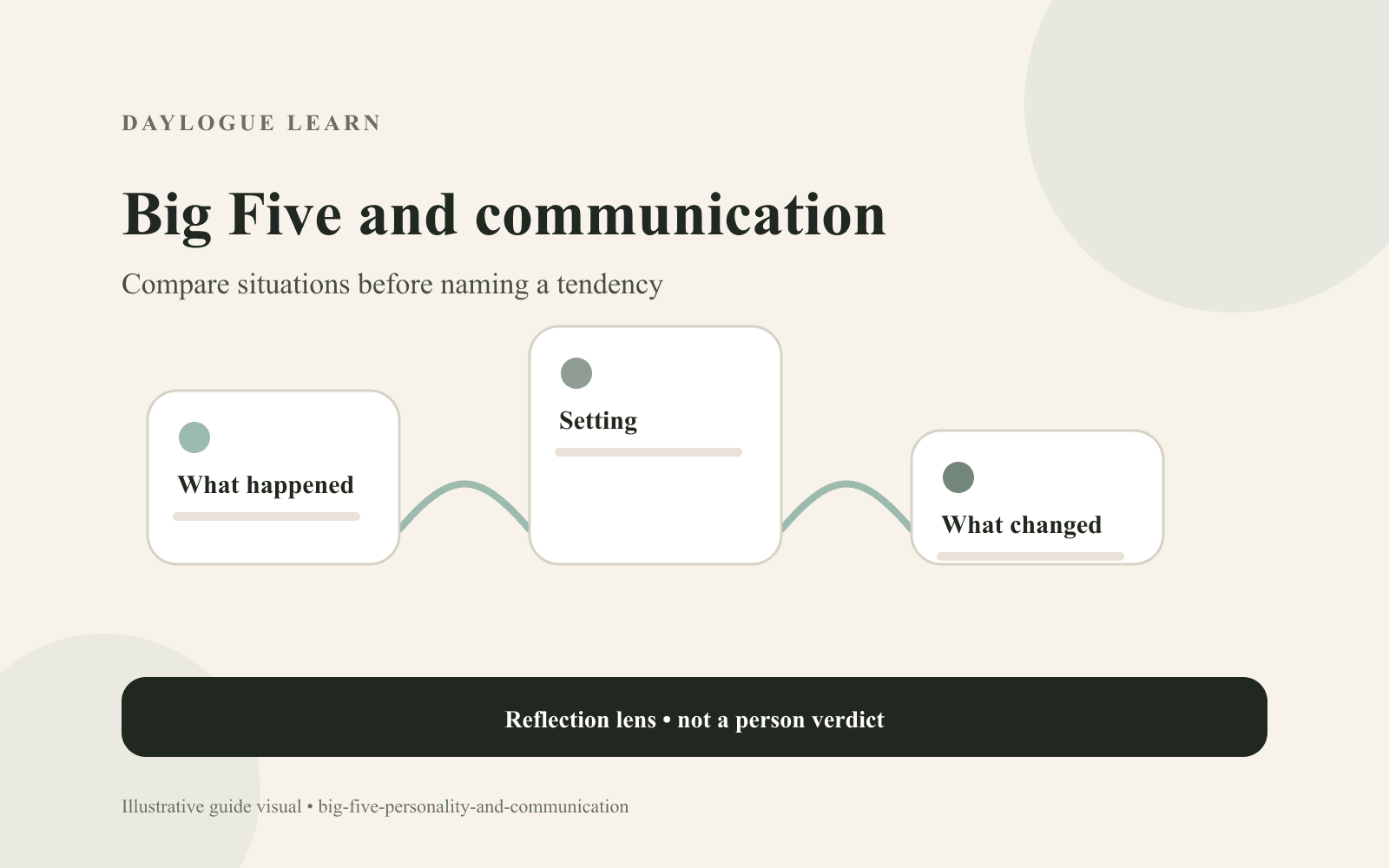
Prepared meetings, spontaneous group conversations, text messages, private talks, and unfamiliar audiences place different demands on communication. A person may speak early when they know the topic and wait when the group is new. That variation is not necessarily inconsistency. It is information about conditions. Include the setting before naming a tendency.
Power also matters. Directness with a peer may not appear with a manager or client. Warmth with a friend may look different under time pressure. A personality score cannot erase those constraints. Ask what the situation allowed, what risk the person perceived, and what alternatives were realistically available in that exchange.
Broad domains are not single behaviors
The Berkeley Personality Lab describes the BFI-2 as a self-report inventory that measures Extraversion, Agreeableness, Conscientiousness, Negative Emotionality, and Open-Mindedness, along with 15 narrower facet traits. The facet structure is a reminder that a broad result can contain narrower differences. Similar extraversion totals can sit beside different answers about sociability, assertiveness, or energy. Similar agreeableness totals can contain different patterns related to compassion, respect, or trust, depending on the instrument.
One vivid conversation cannot supply a missing facet result. Return to the named measure and its item groups when that detail matters. In everyday reflection, describe the behavior directly. “I interrupted twice when the agenda changed” is more useful than “My extraversion took over.” Direct descriptions preserve what can be discussed and changed.
Compare examples across channels
Collect one spoken, one written, and one group example before making a broad claim. Note preparation time, relationship, topic, stakes, and outcome. The same tendency may appear differently across channels. A detailed email may coexist with short spoken answers. An assertive group contribution may coexist with careful listening in a private conversation.
Give counterexamples equal weight. If someone usually avoids disagreement but raised a concern when responsibilities were unclear, preserve that scene. Ask what made directness possible. Perhaps the request was concrete, the role was clear, or preparation reduced uncertainty. The exception may reveal a practical condition worth repeating without redefining the person.
The questionnaire source matters
The official IPIP website says its pool contains over 3,000 items and more than 250 constructed scales. That breadth means an online “Big Five communication” result may be based on different items or scales from another site using similar labels. The instrument name, item count, scoring method, and result date keep its wording connected to the communication scenes it prompted.
Big Five results are not equivalent to MBTI, DISC, Enneagram, or a custom communication type. The frameworks use different constructs and scoring systems. A polished crosswalk can look precise without establishing equivalence. Each result can remain in its own language, with ordinary examples showing what each description brings to mind.
Make one request the next exchange can test
A communication insight becomes useful when it leads to a small request. “Could you send the topic before the meeting?” is clearer than using a trait label to demand more planning. “Can we each finish our thought before responding?” is clearer than using extraversion as a person verdict. A request keeps the focus on behavior and gives everyone room to propose another workable option.
Name your own contribution as carefully as the other person's impact. You might say, “I was trying to create momentum, and I answered before you had time to finish.” Intention explains part of the scene but does not erase the effect. Ask what the other person experienced instead of using their expression or voice tone as proof of an emotion they did not name.
After the next exchange, review the same elements: words, timing, intention, reported impact, and setting. If the change helped, record the conditions that made it possible. If it did not, revise the request rather than declaring a permanent style. One interaction can support an adjustment. It cannot settle who either person is.
Where Daylogue fits
Daylogue offers the public-domain 50-item IPIP Big-Five Factor Markers with standard reverse-key scoring. Its Reflection Profile uses six Daylogue-specific dimensions and is not equivalent to Big Five scores or a communication assessment. It is a non-clinical self-awareness quiz. Later check-ins can help a person preserve the communication moments they choose to record.
Daylogue reads what people choose to write or say. It does not infer emotion or personality from facial expression, voice tone, or physiology. A check-in may provide an example or counterexample for reflection, but it does not silently update a trait result. The person can disagree with any pattern candidate and return to the original source moments.
A communication review workflow
Write the exchange in five parts: setting, exact words or action, intention, observed response, and missing context. Then add one counterexample from a different setting. Only after that should you ask whether a trait description offers useful vocabulary. Phrase the connection cautiously and keep the event available beside it.
Finish with a request or experiment you control. You might ask for ten minutes to prepare, repeat back an assignment, name uncertainty earlier, or invite another viewpoint before deciding. The trait score does not prescribe that choice. The source scene and the person’s own goal do. Review what happened next without grading the person.
Build a channel comparison
Choose the same kind of message across two channels, such as asking for clarification in a meeting and in writing. Record preparation time, audience size, stakes, exact wording, response, and what you wish you had added. The comparison may show that the setting supports different behavior. Someone who speaks briefly in a crowded call may write a detailed follow-up. That is not proof of two personalities. It is a clue about time, turn-taking, permanence, and the opportunity to revise before sending. Keep those mechanics beside any trait vocabulary.
Repeat the comparison once when the stakes are lower. A single tense exchange can dominate memory, especially when its outcome still matters. A lower-stakes example reveals which parts of the communication pattern remain and which disappear. Then write a narrow observation with a source boundary, such as ‘I ask more follow-up questions in writing when I have time to reread the request.’ The observation can remain narrower than a permanent style or skill rating. The next step can be practical, like requesting an agenda, pausing before replying, or confirming the assignment in one sentence. After the next exchange, return to the source note and record what changed. Include the other person’s correction when they offer one, and keep any moment that contradicts your first summary. A communication observation should remain close to the words and settings that produced it. That makes revision possible and keeps a polished trait explanation from replacing the conversation itself. Keep the date, channel, audience, and original words with every later summary.
Worksheet
Communication scene review
Use this page-scoped worksheet to keep the instrument, source scene, uncertainty, and next reflection question together without assigning a person verdict.
- Write the exact words or action you remember.
- Name what you intended the other person to understand.
- Describe the setting, relationship, and time pressure.
- Record the response you observed without guessing motive.
- Add one counterexample from another communication setting.
- Turn any trait label into a tentative question.
- Write one clearer request or sentence for next time.
Common questions
Does the Big Five measure communication style?
The Big Five measures broad personality dimensions through a named questionnaire. It can suggest reflection questions, but it does not assign one fixed communication style.
Does higher extraversion mean better communication?
No. Extraversion is not a communication-skill grade. Preparation, listening, clarity, setting, and the needs of the exchange all matter.
Can agreeableness predict conflict avoidance?
A score may raise a question about cooperation or directness, but it cannot predict every response. Look at specific conflicts and counterexamples across settings.
Should I convert Big Five scores into DISC or MBTI styles?
No. The frameworks use different constructs and scoring. Keep each result separate and compare only the ordinary situations their wording brings to mind.
Does Daylogue analyze voice tone for communication traits?
No. Daylogue works from what people choose to share and does not infer emotion or personality from how a voice sounds.
Sources
Sources were checked on the dates shown. Product details and policies can change.
- International Personality Item Pool · Oregon Research Institute · checked August 21, 2026
- Berkeley Personality Lab: Big Five Inventory 2 · Berkeley Personality Lab · checked August 21, 2026
- Daylogue Big Five personality test guide · Daylogue · checked August 21, 2026
Keep exploring
Big Five personality test guide
Start with the Big Five model, its five domains, scoring basics, and limits.
Read morePersonality tests for self-awareness
Compare assessment frameworks without treating a result as a person verdict.
Read moreDaylogue Reflection Profile
Try Daylogue’s non-clinical self-awareness quiz and keep its result in context.
Read moreDaylogue is not therapy and is not a replacement for professional care.