Written by Daylogue Editorial Team. Published August 21, 2026. Reviewed and updated August 21, 2026.
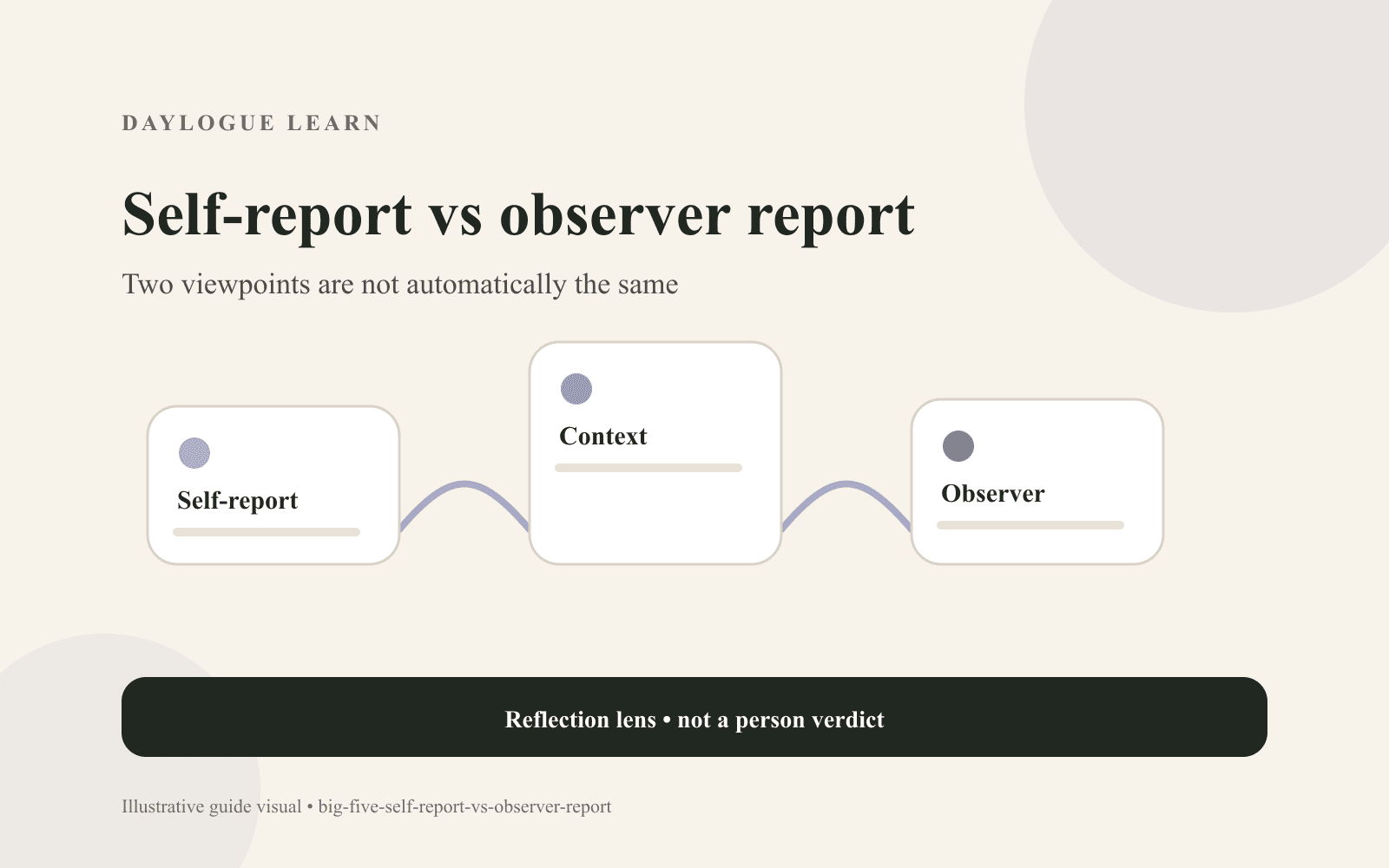
A Big Five self-report summarizes how you describe your own tendencies. An observer report summarizes what another person has seen. Self-report has access to private thoughts and intentions. Observer report has distance from your self-image but only sees selected settings. Neither viewpoint automatically outranks the other. Use matched instruments, clarify the observation period and relationship, then compare specific examples and counterexamples instead of turning disagreement into a verdict.
Two reports answer related but different questions
A self-report asks what you recognize across your own thoughts, feelings, and behavior. You can draw on quiet moments no one saw, intentions that never became action, and settings that different people know separately. An observer report asks what another person has noticed from the outside. They may see recurring behavior you normalize, but they cannot directly access every motive or private reaction.
The BFI-2 is designed as a self-report inventory, and the Berkeley Personality Lab also makes adapted forms available for parents to report on children. That distinction matters. Changing the respondent changes the evidence source even if the broad domains remain familiar. A partner, colleague, sibling, and parent each have different opportunities to observe you. Their reports can all be sincere and still differ.
Read the reports as two camera positions, not competing court testimony. First ask what each person could reasonably see. Then ask which roles and time periods were most available to them. A colleague who knows your meeting behavior may not know how you recover afterward. A close friend may see your spontaneity but not the routines that hold your work together.
| Viewpoint | Useful access | Common blind spot |
|---|---|---|
| Self-report | Private reactions, motives, and behavior across settings | Self-image and intentions may outweigh observable action |
| Close observer | Repeated behavior and change over time | May know only one role or relationship |
| Work observer | Planning, directness, and group behavior at work | May not see home life or quiet time afterward |
| Family observer | Long history and familiar patterns | Old roles can color current observations |
| New observer | Fresh view of present behavior | Limited history and fewer contexts |
Match the instrument before comparing people’s answers
Big Five names a model, not one fixed questionnaire. Make sure both respondents used forms intended to be compared. Record the instrument, version, item wording, response scale, scoring method, and reference information. If one person took a 60-item BFI-2 and another completed an unnamed ten-item quiz, numerical differences mix viewpoint with instrument design.
The BFI-2 measures five domains and 15 facets with 60 short items. The International Personality Item Pool contains public-domain items and many scales, including multi-construct measures of five major personality factors. Those resources support different implementations. A site should identify the exact observer form rather than simply changing pronouns in a self-report and assuming the scores mean the same thing.
Use the same time frame as well. 'Usually,' 'during the past month,' and 'at work this quarter' create different tasks. Ask observers to answer from behavior they have actually seen and to leave uncertainty open when their exposure is limited. A forced confident response does not create better knowledge.
- Use matched self and observer forms when available.
- Keep item wording and response anchors aligned.
- Name the same observation period for both respondents.
- Record the relationship and settings each observer knows.
- Percentiles from different norm groups cannot establish direct disagreement.
Why sincere ratings can differ
Opportunity to observe is the simplest reason. You may know that you wanted to speak in a meeting, while the observer saw silence. You may feel disorganized because of the effort required to meet deadlines, while colleagues see work delivered on time. Both reports describe something real: internal effort and visible outcome. The useful question is which layer the item intended to capture.
Roles change behavior. Someone may be assertive while leading a familiar team and reserved at a neighborhood gathering. A partner may see emotional reactions that never appear at work. A sibling may remember a younger version of you and interpret current behavior through that history. Instead of averaging the conflict away, label the setting attached to each report.
Words can also split interpretations. Cooperative might mean avoiding conflict to one person and working through disagreement to another. Organized might mean a clear desk, dependable follow-through, or detailed planning. Ask each respondent for the scene behind a surprising answer. Specific behavior is easier to compare than an argument about the adjective.
| Source | Self-report may emphasize | Observer may emphasize |
|---|---|---|
| Intent versus action | What you meant or tried to do | What happened visibly |
| Effort versus outcome | How hard a behavior felt | Whether the result arrived |
| Private versus shared setting | Reactions outside the observer's view | Repeated behavior in shared spaces |
| Current versus remembered self | Recent changes | A longer relationship history |
| Word meaning | Your private definition | Their practical example |
Move from ratings to inspectable scenes
Pick one item or facet with a noticeable gap. Each person writes one recent scene that supports their rating. Include what happened, the setting, the behavior, and what was not visible. Then each adds a counterexample. This method makes disagreement smaller and more precise. You may discover that the ratings describe different settings rather than different beliefs about the same event.
Use sentences that keep ownership clear. 'I rated myself higher on sociability because I initiate plans with close friends.' 'You rated me lower because I rarely start conversations at large events.' Both can stand. Identity-invalidating claims about either person's self-knowledge or attention close the comparison instead of clarifying it. The assessment has no authority to decide whose viewpoint counts.
If the gap remains, preserve it. The correct outcome is not always agreement. An observer may have useful evidence that you want to watch, while you retain access to internal context they lack. Write a question for the next few weeks: when do I initiate, what makes it easier, and where does the opposite happen?
01
Choose one gap
Select one domain, facet, or item rather than debating the whole profile.
02
State each viewpoint
Let each respondent explain the rating without interruption or correction.
03
Name one scene
Use a recent event with observable behavior and relevant private context.
04
Add a counterexample
Give equal space to a moment that bends each account.
05
Keep an open question
Decide what to observe next without requiring a winner.
Set consent and privacy boundaries before inviting an observer
An observer report works only with voluntary participation. A clear invitation can explain why you are asking, what the observer will see, where answers will be stored, and whether results will be shared back. A private request preserves choice, while hidden collection or a public surprise undermines consent and cannot support a fair decision about a person.
Keep the result under the participant's control. In workplaces, schools, teams, and families, personality language can feel authoritative even when the exercise began casually. A score should not become a file that follows someone, a ranking, or a shortcut around direct conversation. If the setting carries a power difference, consider whether the request can genuinely be declined.
Separate reflection from evaluation. The aim is to compare viewpoints and notice context, not to identify who is difficult, who fits, or who should change. If a disagreement concerns a real need, state the need directly. 'Please send the plan by Thursday' is clearer and fairer than using a conscientiousness score as proof.
- Ask before sending an observer form.
- Explain storage, visibility, and deletion.
- Let the observer skip items they cannot judge.
- A score has no authority to pressure someone during a conflict.
- Translate any useful insight into a concrete request.
Read agreement and disagreement with the same caution
Agreement can feel reassuring, but it is not proof of a permanent trait. Two people may share the same setting, expectations, and cultural language. Their matching answers still summarize a period and set of observations. Ask where the description fits and where both viewpoints might miss a different context.
Disagreement is not evidence that someone lied or lacks self-awareness. It can reflect private experience, limited observation, role-specific behavior, item ambiguity, or different standards for words such as often. If you suspect impression management, return to examples rather than assigning motive. Observable scenes allow correction. Speculation about character closes the conversation.
Combining two reports would invent a total personality score the instruments did not provide. Compatibility predictions and true-identity claims also exceed their scope. Keeping the instrument, respondent, date, setting, examples, and counterexamples attached shows whose view is whose.
Use your own daily record to add context, not a verdict
Daylogue is a system for self-understanding. Pattern journaling is how it reads you. A small record might include the meeting where you stayed quiet, the dinner where you initiated conversation, and the private energy cost after each. That context makes a broad rating more readable while keeping authorship with you.
Invite another person's perspective only when consent and trust make it useful. Your entries remain your own record. A repeated observation should stay linked to the moments behind it and open to disagreement. The result is not a person verdict. It is one more question you can choose to examine.
Worksheet
Self-report and observer-report comparison
Use one disagreement to compare viewpoint, opportunity to observe, examples, and counterexamples without choosing a winner.
- Exact instrument and matched form
- Observation period used by both people
- Relationship and settings the observer knows
- One item or facet with a clear gap
- Self-report example and private context
- Observer example and visible behavior
- A counterexample for each viewpoint
- A direct request, if a practical need emerged
- An open question to watch without a verdict
Common questions
Is a Big Five observer report more accurate than self-report?
Not automatically. Observers can notice repeated visible behavior, while self-report has access to private thoughts, effort, and settings the observer never sees. Use matched methods and compare the evidence each viewpoint can reasonably provide.
Who should complete an observer personality report?
Choose someone who knows you well across the period and setting named by the questionnaire, understands the request, and freely agrees. One observer may still know only one role, so record the relationship and contexts they see.
What if my observer's Big Five ratings upset me?
Pause before debating the score. Ask for one recent example, offer your internal context, and add a counterexample. You can decline further discussion or use of the report. No rating gives another person authority over your identity.
Can I average self and observer scores?
An average is only interpretable when the instrument's documented method explicitly supports it. The viewpoints contain different information, and keeping them separate often reveals more than collapsing them into one number.
Can observer reports predict relationship compatibility?
No single Big Five profile or paired report should be read as a compatibility forecast. Use any shared language to discuss concrete moments, needs, and differences while leaving room for context and change.
Sources
Sources were checked on the dates shown. Product details and policies can change.
- Berkeley Personality Lab: Big Five Inventory 2 · Berkeley Personality Lab · checked August 21, 2026
- International Personality Item Pool · Oregon Research Institute · checked August 21, 2026
Keep exploring
Big Five personality test guide
Start with the Big Five model, its five domains, scoring basics, and limits.
Read morePersonality tests for self-awareness
Compare assessment frameworks without treating a result as a person verdict.
Read moreDaylogue Reflection Profile
Try Daylogue’s non-clinical self-awareness quiz and keep its result in context.
Read moreDaylogue is not therapy and is not a replacement for professional care.