Written by Daylogue Editorial Team. Published August 21, 2026. Reviewed and updated August 21, 2026.
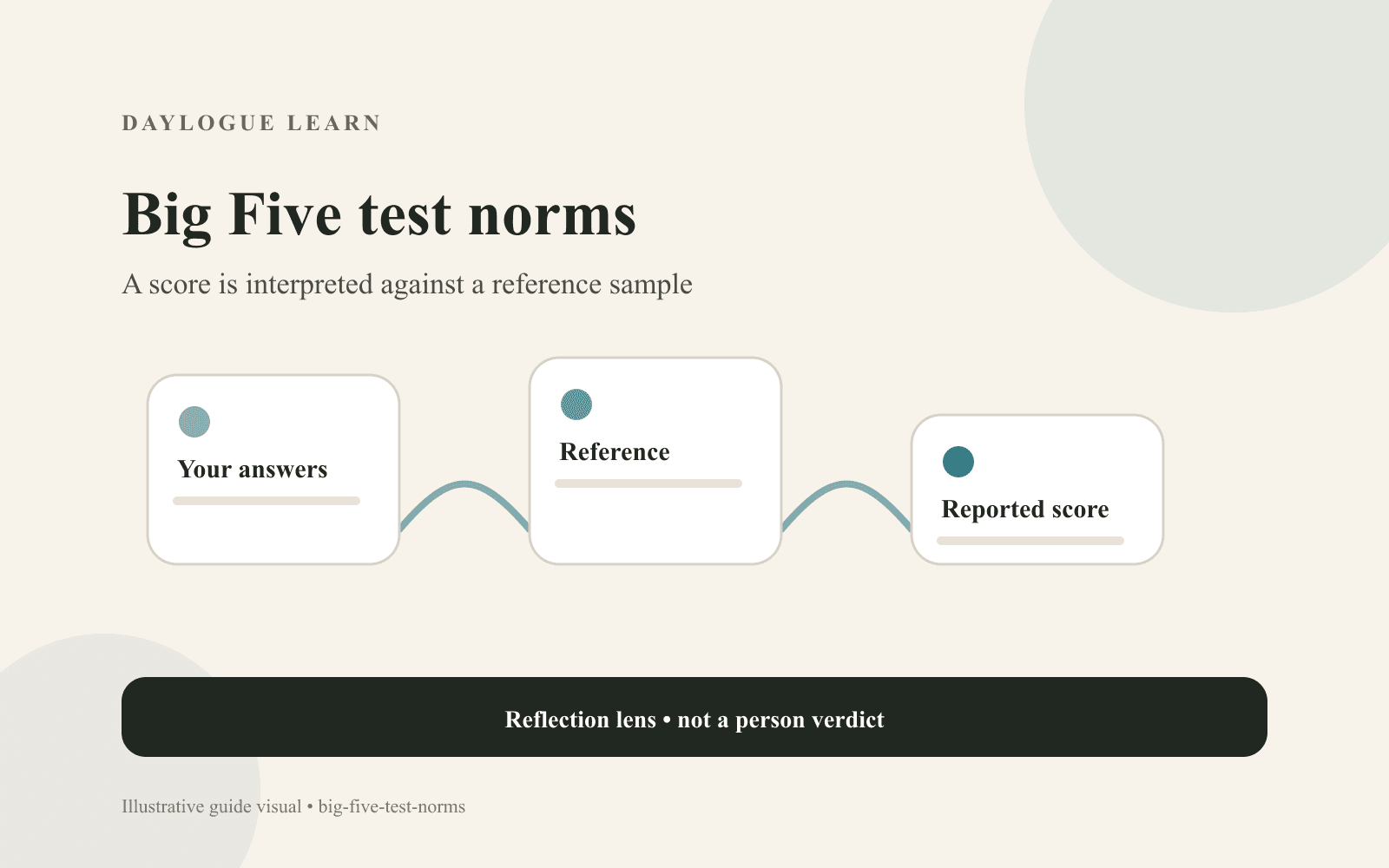
Big Five test norms are reference data used to compare a person’s questionnaire score with scores from a defined sample. A percentile belongs to that instrument, scoring method, and comparison group. Change the sample or the questionnaire and the same answers may be presented differently. Read the norm details before comparing two reports.
What test norms do
A norm gives a score a comparison frame. If a report says a result is at the 70th percentile, it usually means the score was higher than about 70 percent of scores in the reference sample used by that report. It does not mean the person has 70 percent of a trait. It does not say that the position would remain the same in every population or on every questionnaire.
Raw scores and normed scores answer different questions. A raw score summarizes selected responses according to the instrument’s scoring rules. A normed result places that score against reference data. Keep both ideas separate. A precise-looking percentile can hide uncertainty when the report does not identify the sample, its size, when it was collected, or how closely it matches the intended use.
The reference sample matters
A comparison sample may come from one country, language, age range, research panel, student group, or general population. Each choice shapes the distribution used for interpretation. That does not make norms deceptive. It makes their scope important. Before using a percentile, ask who supplied the reference answers and what reason exists to compare the current respondent with that group.
Group-specific norms can sometimes make a comparison more relevant, but they can also invite overconfident conclusions if the categories are poorly explained. A report should state which sample it used rather than silently selecting one. When the sample is unknown, keep the result in raw-score or descriptive terms and mark the missing reference information instead of filling it with an assumption.
How one raw score can look different
Picture the same raw conscientiousness score placed against two reference distributions. If one sample tends to report higher conscientiousness, the percentile may be lower there. If another sample tends to report lower scores, the percentile may rise. The answers did not change. The comparison frame did. That is why percentile differences should not automatically be read as personality change.
Scoring conversions can add another layer. Some reports use means, standardized values, percentage-of-maximum scales, bands, or custom labels. “High” on one website may not begin at the same point as “high” on another. Save the numerical scale and its labels together. A number separated from its scoring key cannot support a fair cross-test comparison.
Instrument structure comes first
The Berkeley Personality Lab describes the BFI-2 as a self-report inventory that measures Extraversion, Agreeableness, Conscientiousness, Negative Emotionality, and Open-Mindedness, along with 15 narrower facet traits. That structure matters when reading any norms supplied for it. A domain percentile and a facet percentile refer to different item sets, so a domain reference group cannot create a missing facet result and another Big Five measure may organize narrower traits differently.
Longer measures may report more facets, while shorter forms may focus only on broad domains. Fewer items can reduce burden, but it also leaves less information behind each score. Norms cannot restore detail the questionnaire did not collect. Choose the measure for the decision or reflection task, then read only the dimensions and comparisons it actually provides.
Compare two reports carefully
When two Big Five reports disagree, line up the instrument name, version, item count, response scale, scoring method, norm sample, and test date. Differences in any of those fields can change the displayed result. Timing and answer context matter too. A person may answer with work behavior in mind during one sitting and a broader life frame during another.
Neither the more flattering nor the more precise-looking report establishes the “real” person. Item content, reference information, current examples, and counterexamples offer a more transparent account of why the numbers may differ. The questionnaires can remain separate snapshots without requiring one to win.
Public item pools still need scoring context
The official IPIP website says its pool contains over 3,000 items and more than 250 constructed scales. IPIP also provides public material related to items, scales, scoring, and norms. Public-domain status makes the content inspectable, but sites using IPIP items may still apply different scales, samples, scoring keys, or feedback language.
Ask the website to name the exact IPIP scale and show how results are calculated. A generic OCEAN label is not enough to reconstruct the measure. If norm data comes from the site’s own users, look for information about selection and timing. People who choose to take an online personality quiz may differ from the wider population a reader assumes the percentile represents.
Write a summary proportionate to the norm data
After checking the instrument and sample, explain the result in one sentence that keeps every boundary visible. For example: “On this version, my responses fell above the center of the stated comparison group for conscientiousness.” The sentence names the source of the number and avoids turning rank into identity. If the provider does not identify the sample, say that the comparison group is unknown rather than filling the gap with an assumption.
Then place the percentile beside two ordinary scenes. Choose one that fits the report and one that bends it. A person can rank above a reference group's center on a broad domain and still behave differently when the role, energy, stakes, or expectations change. The counterexample does not cancel the percentile. It restores information that the comparison number was never designed to contain.
Avoid combining the five percentiles into an average. The domains are separate descriptive dimensions, and a single total would invent a scoring rule the instrument did not provide. Avoid ranking friends or partners as well. If a number prompts a practical question, ask about the concrete behavior directly and let each person supply their own context.
Where Daylogue fits
Daylogue offers the public-domain 50-item IPIP Big-Five Factor Markers with standard reverse-key scoring. Its separate Reflection Profile does not translate into Big Five domains, percentiles, or normed scores. The frameworks can sit beside each other as different reflective snapshots, but their dimensions and comparison methods should not be presented as equivalent.
A later Daylogue check-in can preserve a scene that helps someone examine a past result. It does not recalculate the questionnaire or move its percentile. Daylogue works from what people choose to share. It does not infer personality from facial expression, voice tone, or physiology. Keep the named assessment and its reference group attached to the original score.
A norm-reading workflow
First, capture the instrument and version. Second, identify the number type. Third, locate the comparison sample. Fourth, note any demographic or language grouping. Fifth, read the caveats supplied by the publisher. Complete those steps before interpreting a percentile or comparing reports. If a field is missing, write “unknown” instead of guessing from the site’s design.
Then move from numbers to scenes. Ask where the description fits, where it bends, and which situations may have shaped the answers. A norm can tell you how a score sits in a sample. It cannot decide which behavior is valuable, predict every choice, or rank the worth of the person who completed the questionnaire.
Questions for an unclear score report
If a report presents a percentile without a reference sample, ask the publisher which data set produced the comparison and whether the same norms apply to the version you completed. Also ask when the sample was collected, which languages were used, how missing answers were handled, and whether the online feedback uses the official scoring key. These details are not decorative methodology. They determine what the displayed position can reasonably mean. If the answers are unavailable, preserve the raw result as a snapshot with incomplete context instead of borrowing certainty from the chart design.
For a cross-test comparison, make a small table with one row per report and columns for instrument, version, items, response scale, score type, reference group, and test date. Leave unknown fields blank. Then compare only what the table shows is comparable. A domain label shared by two reports does not establish identical item content, facet coverage, or norms. The table may reveal that the numbers answer different questions. That is a useful outcome. It prevents a percentile shift from being mistaken for personal change and keeps the interpretation attached to verifiable scoring information.
Worksheet
Big Five norm-reading checklist
Use this page-scoped worksheet to keep the instrument, source scene, uncertainty, and next reflection question together without assigning a person verdict.
- Record the exact instrument name and version.
- Find the population used as the comparison sample.
- Check whether age, language, country, or other groups are separated.
- Write down whether the report shows raw scores, averages, ranges, or percentiles.
- Keep numbers from different instruments separate until their scoring basis is clear.
- Save the test date and administration context.
- Keep missing norm information marked as unknown.
Common questions
What are Big Five norms?
They are reference data used to compare a questionnaire score with scores from a defined sample. The meaning depends on the instrument, scoring method, and sample.
Does the 70th percentile mean 70 percent of a trait?
No. It usually describes a position relative to the chosen reference sample, not the amount of a personality trait inside a person.
Can I compare percentiles from two Big Five tests?
Only after confirming the instrument, item set, scoring scale, and reference data are comparable. Similar labels alone do not make the numbers interchangeable.
Why would the same answers produce a different percentile?
A different norm sample or scoring conversion can change the displayed position even when the underlying response pattern stays the same.
Does Daylogue provide Big Five norms?
Daylogue offers the public-domain IPIP 50-item Big-Five Factor Markers and reports mean item scores without percentiles or norms. Its separate Reflection Profile is not translated into Big Five scores.
Sources
Sources were checked on the dates shown. Product details and policies can change.
- International Personality Item Pool · Oregon Research Institute · checked August 21, 2026
- Berkeley Personality Lab: Big Five Inventory 2 · Berkeley Personality Lab · checked August 21, 2026
- Daylogue Big Five personality test guide · Daylogue · checked August 21, 2026
Keep exploring
Big Five personality test guide
Start with the Big Five model, its five domains, scoring basics, and limits.
Read morePersonality tests for self-awareness
Compare assessment frameworks without treating a result as a person verdict.
Read moreDaylogue Reflection Profile
Try Daylogue’s non-clinical self-awareness quiz and keep its result in context.
Read moreDaylogue is not therapy and is not a replacement for professional care.