Written by Daylogue Editorial Team. Published August 21, 2026. Reviewed and updated August 21, 2026.
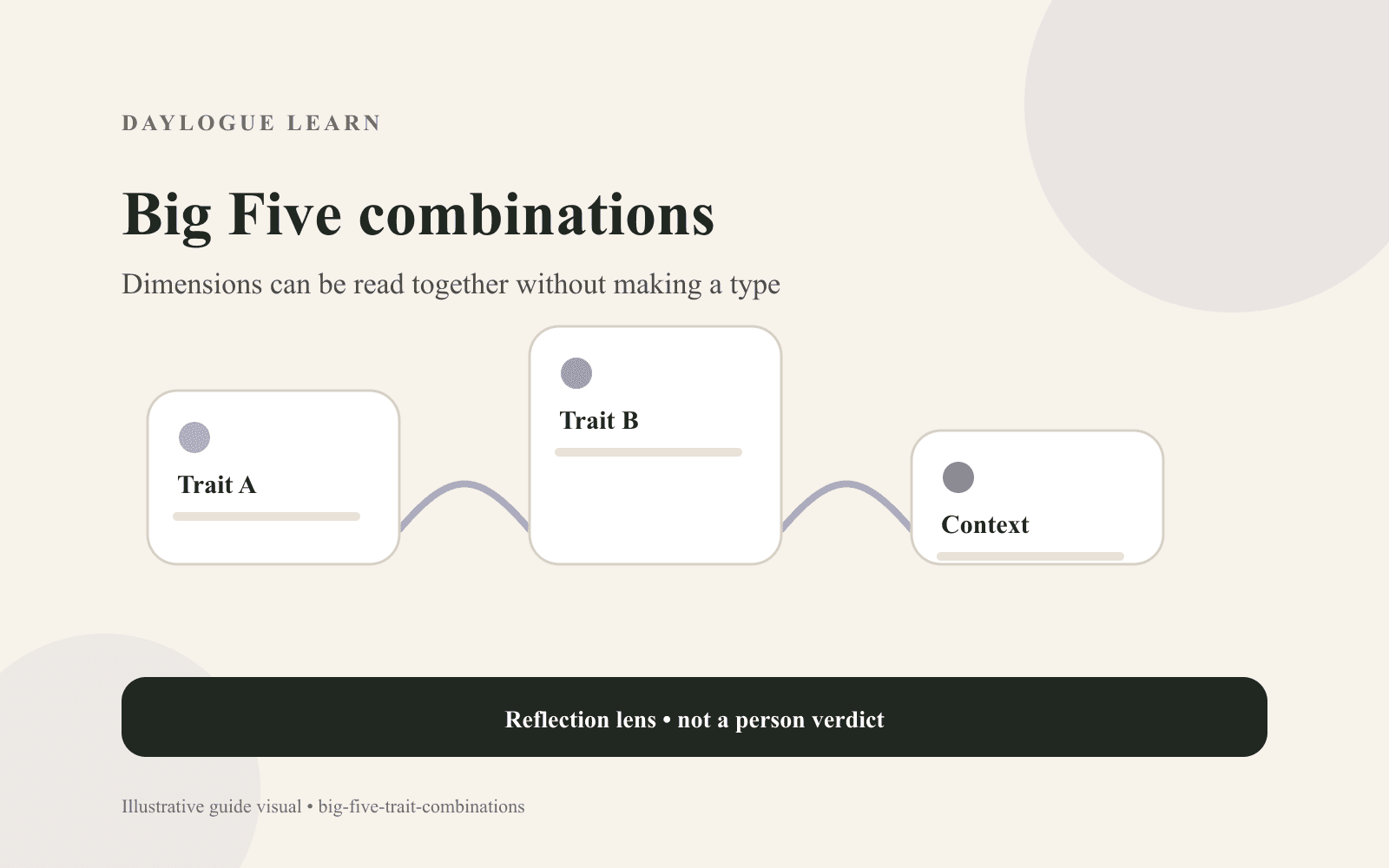
Big Five trait combinations are profiles made by reading several dimensional results together. The dimensions do not merge into a hidden type, and one score does not automatically explain another. Start with each instrument result, then use a specific scene to ask how two tendencies appeared together. Keep counterexamples, facets, norms, and context visible so the profile stays descriptive rather than becoming a prediction.
A profile is not a type
A Big Five profile contains positions on five dimensions. Reading two dimensions together can create a useful question, such as how assertiveness appears alongside cooperation or how novelty preference appears alongside planning. The combination does not create a sixth score, a named category, or a rule for what the person will do.
The Daylogue Big Five guide explains that scores fall on spectrums and do not sort people into a small set of fixed types. That remains true when dimensions are placed side by side. A memorable label may be tempting, but it discards scale, facets, item wording, and the contexts where another response appears.
Interpret each dimension separately first
Before combining results, verify the instrument, version, scale, scoring direction, and reference group for each one. Translate each reported position into plain language without value judgments. If a dimension is unclear alone, combining it with another will add narrative confidence without adding evidence.
Keep each score’s uncertainty intact. A middle result may hide facet differences. A high or low percentile depends on a comparison sample. A broad domain may not match every item. Write those limits beside the number before asking how two tendencies might operate in the same scene.
Use one scene as the meeting point
Consider a project lead who welcomes an unfamiliar idea and also builds a careful implementation checklist. That scene may fit higher openness and higher conscientiousness, but the labels do not explain the behavior on their own. The project, responsibility, team, and stakes all belong in the record.
Now add a counterexample: the same person rejects a spontaneous weekend plan and leaves personal paperwork unsorted. The combination looks different because the setting changed. Keep both scenes. The point is to inspect when tendencies appear together, not to prove that the paired scores define the person.
| Pairing question | Scene to inspect | Limit to preserve |
|---|---|---|
| Novelty and structure | Trying a new method with a detailed plan | One domain does not cause the other |
| Sociability and directness | Speaking up in a familiar group | Social energy and cooperation remain separate |
| Reactivity and planning | Preparing carefully for uncertain stakes | A test result does not explain the source of emotion |
| Cooperation and boundaries | Helping while making a clear request | Accommodation is not the same as agreement |
Facets can change the apparent combination
The BFI-2 is a 60-item self-report inventory designed to measure five broad dimensions and 15 more-specific facet traits. Facets matter because two people with similar broad profiles can reach them through different narrower response patterns. One extraversion result might lean more on sociability, another on assertiveness.
Facet detail is available only when the test measured and reported it. If the report includes facets, keep each attached to its domain and instrument wording. If it does not, use ordinary examples to explore possible distinctions without presenting those reflections as unofficial scores.
Use language that does not invent interaction effects
It is safe to say that two reported results appear in the same profile. It is also safe to ask how both descriptions fit one event. It is not safe to claim that one trait amplifies, cancels, protects against, or causes the other unless the source and analysis specifically support that statement.
Prefer sentences with visible evidence: “In this planning meeting, I welcomed a new approach and asked for a detailed timeline.” Avoid sentences that sound predictive: “My openness plus conscientiousness makes me an innovative strategist.” The first can be checked against the scene. The second turns a profile into a flattering type.
Know which measure produced the profile
The IPIP website includes over 3,000 items and over 250 scales, and its items and scales are in the public domain. A questionnaire built from IPIP items should identify the exact scale, item count, and scoring method. The pool itself is not one single Big Five test with one universal profile format.
If two websites produce different combinations, compare the measures before comparing the stories. Check item wording, response scale, reversed items, reference data, and whether both report the same domains and facets. Shared OCEAN language does not make the resulting numbers directly interchangeable.
Common combination misreads
One mistake is multiplying certainty: reading two uncertain scores as a highly certain type. Another is cherry-picking a flattering pairing while ignoring counterexamples. A third is using the profile to judge compatibility, leadership, trustworthiness, or future success. Those conclusions do not follow from a descriptive combination.
Another mistake is collapsing middle scores into whichever story sounds cleanest. Preserve middles as middles. They may reflect moderate answers, split facets, or context-dependent responses. A good profile interpretation can remain incomplete without becoming useless.
- Watch for a new personality-type label that replaces the dimensional results.
- Watch for causal claims between domains, since paired scores cannot establish them.
- Watch for compatibility advice, which paired scores cannot support.
- Keep middle scores and counterexamples visible in the profile.
- Compare instruments only after checking their items, scales, scoring, and reference groups.
- Keep the profile descriptive rather than turning it into a verdict about a person.
A combination reflection exercise
Choose two dimensions because a real question connects them, not because their pairing has a catchy name. Write each result separately. Add one scene where both descriptions seem visible. Then add a scene where one or both descriptions bend. Record role, stakes, people present, timing, and available energy.
End with a provisional observation that names the scene rather than the person. For example: “During unfamiliar work with clear ownership, I explored options and used more structure.” That sentence preserves the combination, the conditions, and the possibility that another setting will produce a different response.
01
Write each result separately
Keep the instrument, scale, reference group, and uncertainty visible for both dimensions.
02
Choose a shared scene
Find one event where both descriptions seem relevant and record what actually happened.
03
Add a counterexample
Preserve a situation where the pairing looks different rather than explaining it away.
04
Name conditions, not a type
Finish with a contextual sentence that can change when another example appears.
Careful reading notes
Reading two dimensions together can generate a useful question, but it does not create a new personality type. Higher extraversion and lower agreeableness, for example, do not specify how someone will communicate in a particular meeting. The setting, relationship, goal, and narrower response patterns still matter. Describe the combination as two questionnaire results, then look for a scene where both seem relevant and another where one or neither fits. That method keeps the combination descriptive instead of predictive.
Avoid compatibility claims built from paired scores. Two people can answer a questionnaire similarly and still want different things from a relationship. They can answer differently and still communicate clearly. Use combinations to notice possible tensions or tradeoffs in your own examples, not to rank partners, teammates, or candidates. A result can open a conversation about preferences. It cannot decide what another person needs, how a pair will function, or who belongs in a role.
Framework
Big Five combination context frame
A four-part frame for reading two dimensions together while keeping instrument details, separate scores, examples, counterexamples, and context visible.
- Dimension A result and source
- Dimension B result and source
- Scale and reference group for each
- One scene where both descriptions fit
- Observable details from that scene
- One counterexample
- Context that changed
- Facet detail actually reported
- Causal claim to avoid
- Provisional contextual sentence
Common questions
Do two Big Five scores create a personality type?
No. They remain positions on separate dimensions. Reading them together can guide reflection about a scene, but the pairing does not create an official category or fixed identity.
Can one Big Five trait cause another?
A profile alone cannot show that. You can observe that two results appear together and inspect how both descriptions fit an event, but causation requires evidence the profile does not provide.
Which trait combinations are best?
There is no universally best combination. Tendencies can be useful or difficult depending on context, role, resources, and stakes. Avoid grading profiles or turning them into rankings.
Why can similar profiles look different in real life?
Broad scores can hide facet differences, and behavior changes across settings. Roles, familiarity, pressure, relationships, and available energy can all shape which tendency becomes visible.
How should I write about my profile?
Name the instrument and results, then describe one specific example and one counterexample. Keep the dimensions separate and use a provisional sentence about the setting rather than a label for yourself.
Sources
Sources were checked on the dates shown. Product details and policies can change.
- International Personality Item Pool · Oregon Research Institute · checked August 21, 2026
- Berkeley Personality Lab: Big Five Inventory 2 · Berkeley Personality Lab · checked August 21, 2026
- Daylogue Big Five personality test guide · Daylogue · checked August 21, 2026
Keep exploring
Big Five personality test guide
Start with the Big Five model, its five domains, scoring basics, and limits.
Read morePersonality tests for self-awareness
Compare assessment frameworks without treating a result as a person verdict.
Read moreDaylogue Reflection Profile
Try Daylogue’s non-clinical self-awareness quiz and keep its result in context.
Read moreDaylogue is not therapy and is not a replacement for professional care.