Written by Daylogue Editorial Team. Published August 21, 2026. Reviewed and updated August 21, 2026.
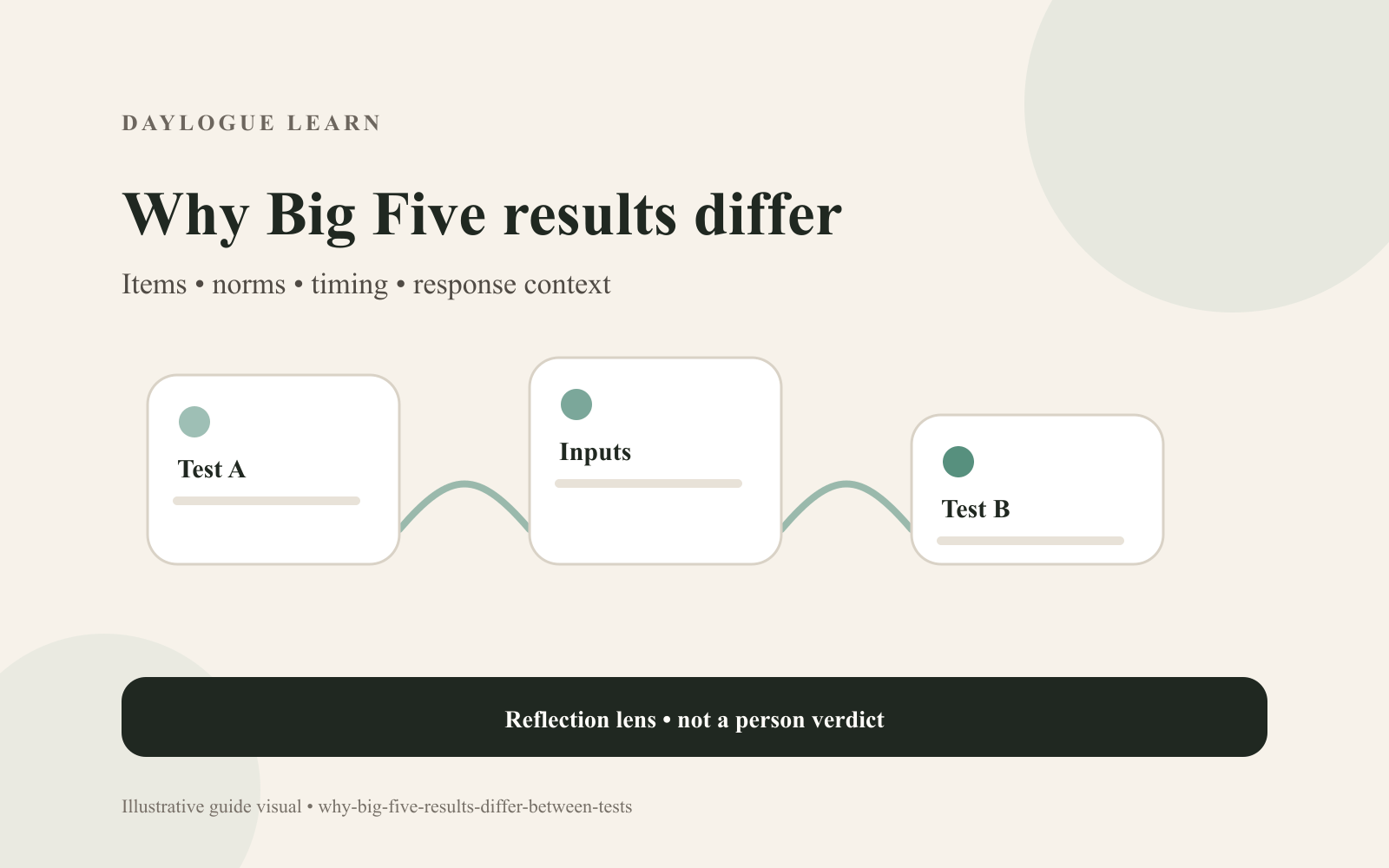
Big Five results differ between tests because Big Five names a model, not one universal questionnaire. Instruments can use different items, domain labels, facets, response scales, scoring formulas, and reference samples. Your timing and interpretation of the questions can also change your responses. Keep each score attached to its instrument and context. Compare broad themes, examples, and counterexamples rather than reading one result as the hidden truth about who you are.
The same model can support different questionnaires
The Big Five organizes personality descriptions across openness, conscientiousness, extraversion, agreeableness, and neuroticism or negative emotionality. Many instruments measure those broad domains. They do not all use the same prompts or narrower facets. A website can honestly say Big Five while sampling different behaviors from the test you took last month. The shared model creates a family resemblance, not interchangeable score sheets.
The BFI-2 is one named 60-item inventory with five domains and 15 facets. The International Personality Item Pool is a public-domain collection containing over 3,000 items and more than 250 scales. An IPIP-based site selects from that larger resource. If the provider does not name its exact scale, item count, and scoring method, you cannot assume that research about the BFI-2 or another IPIP inventory describes its result.
Begin any comparison by making two columns. Record the instrument, version, item count, response labels, domain names, facets, score type, and comparison sample. If several fields are missing, the reports may not support a numeric comparison. You can still ask whether both descriptions point toward a similar question, but keep the uncertainty visible.
| Difference | What may change | How to respond |
|---|---|---|
| Item selection | Which behaviors represent a domain | Compare the questions, not only the labels |
| Facet structure | Which narrower tendencies receive weight | Map facets before matching scores |
| Response scale | How much nuance each answer allows | Save the original anchors |
| Score formula | How items combine and reverse | Keep scales separate without conversion documentation |
| Reference sample | What a percentile compares you with | Record the population and date |
Different wording brings different situations to mind
A broad trait can be represented by many ordinary behaviors. One conscientiousness item may make you think about schedules, another about finishing dull tasks, and another about keeping promises. Your answers can differ because those behaviors differ. A person may keep commitments to other people while leaving personal projects unfinished. A test that samples one side more heavily can produce a different-looking summary.
Words also carry local meanings. Reserved may sound like thoughtful restraint to one reader and social discomfort to another. Relaxed may suggest handling pressure or simply enjoying an unhurried pace. The Berkeley BFI-2 guidance explains that some items use more than one descriptor to clarify the intended concept and reduce a likely misreading. That design choice shows why phrasing is part of measurement, not decoration.
Language and translation add another layer. The BFI-2 publisher advises translators to preserve total item meaning and use back-translation rather than relying on literal word substitution. If you took tests in different languages, record that before reading a score change as personal change. The translated forms may be carefully developed, but the words can still cue different examples from your life.
- Read each item according to its stated meaning, not the trait you think it targets.
- Note words that felt ambiguous or culturally specific.
- Compare the behaviors sampled inside each domain.
- Preserve the language and version with the report.
A percentile can change when the comparison group changes
A percentile does not say how much of a trait you possess. It says where a score falls within a particular reference distribution. Change the reference group and the percentile may change even when the same raw responses stay fixed. Age range, language, location, recruitment, and other sample details can shape that distribution. A test should identify the comparison group clearly enough for you to understand the frame.
The Berkeley Personality Lab states that there is no official BFI-2 manual with published norms, while pointing readers to published means for an American sample across ages 20 to 60. That is a useful warning against reading every online BFI-2 percentile as universal. Ask which norms the provider used and how the displayed number was calculated.
Score formats differ too. One report may show an average from one to five, another a percentage of the maximum possible, and another a percentile. A 70 on one screen and a 70th percentile on another are not the same quantity. Before comparing, label each number in plain language. If you cannot identify the scale, compare narrative descriptions cautiously and leave the numbers separate.
01
Label the number
Write whether it is a raw sum, average, standardized score, range, or percentile.
02
Find the sample
Record who formed the comparison group and whether it matches the test version and language.
03
Check direction
Confirm which end of the scale represents each domain, especially emotional stability labels.
04
Keep values separate
Unlike scores remain separate because subtracting or averaging them would create an undefined result.
Your response context can move the snapshot
Self-report questions ask you to summarize yourself, and the examples available in memory can influence that summary. Taking a test after a demanding workweek may bring deadlines and tense conversations forward. Taking it during vacation may bring rest, novelty, and sociability forward. That does not mean either result is fake. It means both were answered from a life that contains more than one setting.
Instructions matter. Generally, recently, and in a named situation invite different judgments. So do interruptions, fatigue, rushing, and answering beside someone else. Save basic context: date, setting, recent events, purpose, and whether you completed the test in one sitting. Those notes can explain variation without pretending every difference is caused by the questionnaire.
Avoid immediate retesting to chase agreement. Familiarity can change how you interpret items, and remembering your first answers can pull you toward consistency. If a result feels wrong, read the report, inspect confusing prompts if permitted, and collect real examples. Retake only when you have a reason and can preserve the same instrument and comparable conditions.
| Context | Example note | Why it helps |
|---|---|---|
| Purpose | Curious after a work review | Shows which version of yourself was salient |
| Setting | Phone at home, interrupted twice | Explains attention limits |
| Recent period | Busy deadline week | Preserves unusually available examples |
| Instructions | Answered as I usually am | Clarifies the requested time frame |
| Social setting | Completed privately | Records whether impression pressure may have mattered |
Compare two results without choosing a winner
First, compare instrument facts. If the forms, score types, or norms differ, stop trying to match numbers. Second, compare domain descriptions and facets. Highlight wording that overlaps and wording that asks about different behavior. Third, add one recent example and one counterexample for each surprising domain. This creates a three-layer record: method, result, and lived context.
Use modest language when you summarize. Say, 'On this measure, my answers leaned toward planning, especially in shared projects.' Avoid, 'The second test proved I am highly conscientious.' The first statement identifies the source and a concrete setting. The second turns a changing self-report into a person verdict. Your goal is not to make the assessments agree. It is to understand what each one actually captured.
If both point in a similar direction, read that as a theme worth observing rather than final proof. If they diverge, ask which item content, facet map, norm, or life context differs. Sometimes the honest outcome is unresolved. You can keep both snapshots and wait for more ordinary examples instead of forcing certainty from two reports.
01
Identify each instrument
Write the exact form and version above its result.
02
Normalize the language
Translate report prose into cautious descriptions without converting the numbers.
03
Map domains and facets
Note which labels truly overlap and which only sound similar.
04
Add lived evidence
Record a concrete example and counterexample for the result that matters.
05
Write an open question
End with what you want to observe, not a final claim about who you are.
What a different result does not mean
A changed score does not automatically establish that your personality transformed, the earlier result was invalid, or the newer test discovered a hidden true self. Different item sets, scoring rules, comparison groups, timing, and response contexts can all remain plausible explanations. The most proportionate reading keeps the instrument and circumstances attached to each snapshot.
Difference also does not create a reason to rank yourself. Higher and lower scores are not better and worse versions of a person. A trait can be useful in one scene and create friction in another. Conscientious planning may support a shared project and feel constraining during an open weekend. Direct social energy may help a group start talking and leave less room for quiet voices. Keep value judgments separate from description.
Watch for combining five domains into one personality grade or using differences to predict relationship compatibility. If another person took a test, their result remains their self-report and should stay under their control. Talk about specific behavior and needs instead of wielding a score in an argument.
- Not proof that one test found the true self.
- Not evidence that one score is morally better.
- A descriptive result, not a fixed identity or person verdict.
- Not a compatibility forecast.
- Examples that do not fit remain part of the record.
Let daily context answer what another retest cannot
When two reports disagree, choose one domain and watch it in ordinary life. Note the scene, your action, the expectation in the room, and what happened differently elsewhere. A month of occasional examples can show whether the difference follows work versus home, familiar versus unfamiliar people, structure versus freedom, or another condition you had not named.
You decide what the record means. A surfaced theme should remain linked to examples and open to correction. Counterexamples are not noise to delete. They are often the clearest clue that a setting, relationship, role, or expectation changes how a tendency appears.
Worksheet
Two-result comparison sheet
Keep method, numbers, descriptions, and daily context separate so a score difference stays readable.
- Instrument and version for result one
- Instrument and version for result two
- Item count and response anchors for each
- Score type and reference sample for each
- Domain wording that genuinely overlaps
- Facet content that differs
- Completion date and recent context
- One example supporting each surprising result
- One counterexample for each surprising result
- An open question to observe instead of a verdict
Common questions
Why did my Big Five score change after one week?
The tests may use different items, scoring, or norms, and your response context may also have changed. Identify both instruments before interpreting the difference. A one-week shift is not automatically a change in identity.
Which Big Five result should I trust?
Start with the named instrument that provides clear scoring, source, and comparison information. Then inspect how its descriptions fit examples and counterexamples. Trust should be proportionate to the measure and use, not granted to the more flattering result.
Can two accurate Big Five tests disagree?
They can produce different-looking results because they sample traits differently or use different scales and reference groups. Accuracy is not a single property shared by every use. Keep both reports attached to their methods.
Does a lower percentile mean my trait decreased?
Not necessarily. A percentile depends on the comparison group and scoring method. Compare the instrument, version, raw responses, and norm sample before reading a percentile difference as personal change.
Should I average two Big Five scores?
No. Averaging scores from different instruments or norm groups would create a number with no defined scale. Broad descriptions and real examples provide a more transparent comparison.
Sources
Sources were checked on the dates shown. Product details and policies can change.
- Berkeley Personality Lab: Big Five Inventory 2 · Berkeley Personality Lab · checked August 21, 2026
- International Personality Item Pool · Oregon Research Institute · checked August 21, 2026
Keep exploring
Big Five personality test guide
Start with the Big Five model, its five domains, scoring basics, and limits.
Read morePersonality tests for self-awareness
Compare assessment frameworks without treating a result as a person verdict.
Read moreDaylogue Reflection Profile
Try Daylogue’s non-clinical self-awareness quiz and keep its result in context.
Read moreDaylogue is not therapy and is not a replacement for professional care.