Written by Daylogue Editorial Team. Published August 8, 2026. Reviewed and updated August 8, 2026.
A useful weekly readback should tell you what happened, point to the moments that support its wording, and leave room for the parts that do not fit. Start with one sentence about the week's shape, then name two source moments, one counterexample, and one open question. Keep causes and life verdicts out of the recap. The readback is a reflection aid, and you decide what it means.
A week is not one mood
Monday can feel scattered, Wednesday can feel light, and Friday can end with a difficult conversation. A recap that calls the whole week good or bad loses the very texture that makes review useful. Begin with the shape of the week, then keep the turns visible.
Try a sentence such as, 'The week started rushed, opened up in the middle, and tightened again before the weekend.' That wording gives you something to check. It does not turn seven uneven days into a score or tell you who you are.
Build the readback from source moments
Choose two entries that carry different parts of the week. One might contain the moment the pressure became noticeable. The other might show a quiet reset, a conversation that changed the tone, or a task that took less out of you than expected.
Daylogue stores AI-generated summaries in readable form to power daily narratives, weekly insights, and pattern detection. That makes the saved summary a separate layer from your original check-ins. When wording matters, return to the source moment rather than trusting the recap alone.
| Part | Include | Avoid |
|---|---|---|
| Shape | One sentence describing how the week changed | A single score for the entire week |
| Evidence | Two dated moments in your own words | A claim with no visible source |
| Exception | One day that did not fit the main thread | Discarding a quieter counterexample |
| Question | One thing to notice next week | A rule that dictates a change |
Write a four-part readback
Keep the first version short enough to read aloud. The goal is not to summarize every entry. It is to preserve the week in a form you can inspect without rereading everything, while leaving the original entries available when you want more context.
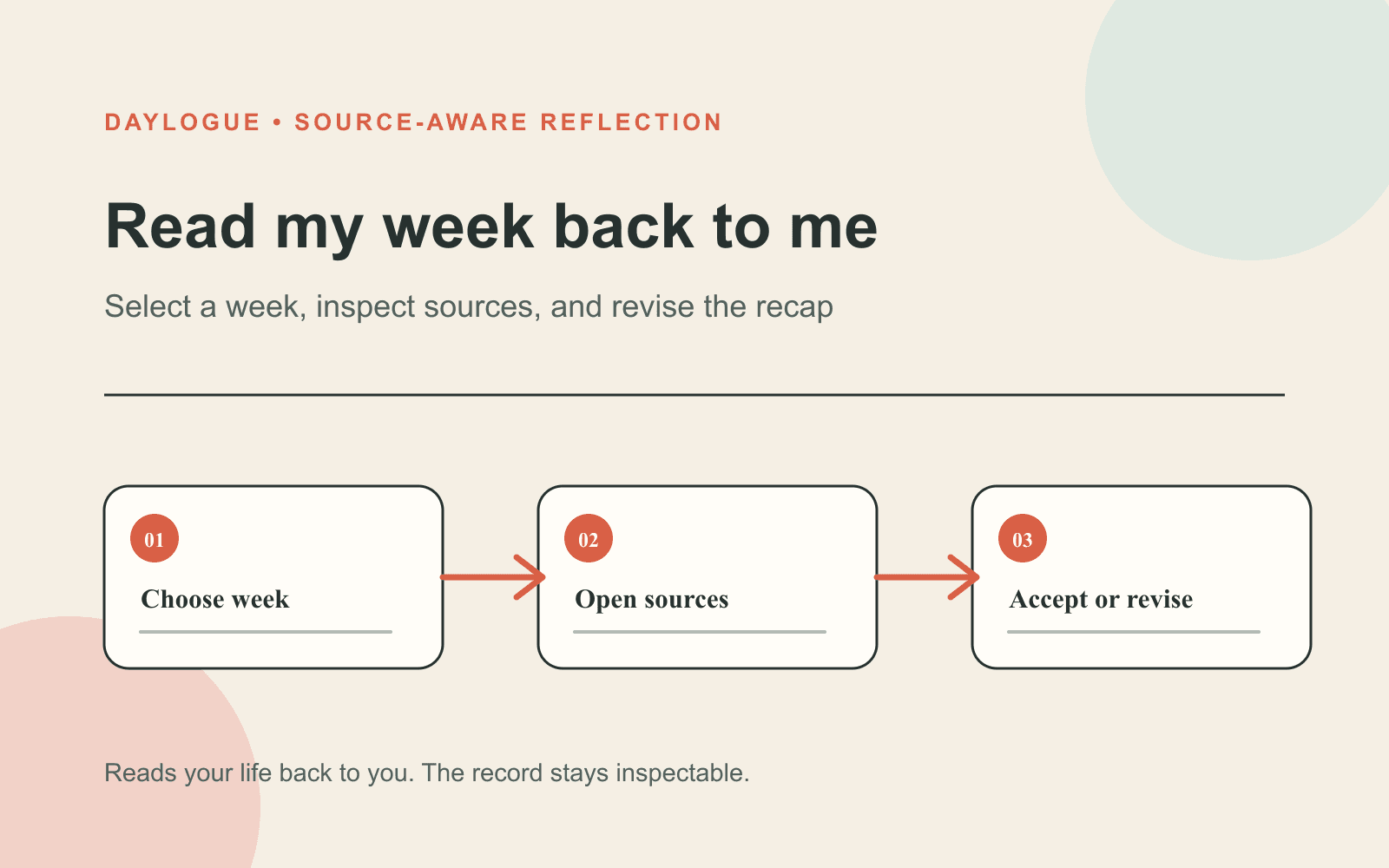
If an automated weekly insight already exists, use the same structure to review it. Copy its main observation, attach two source moments, find one exception, and rewrite the open question in language you would actually use. You can agree with part of a read without accepting all of it.
01
Name the week's shape
Write one sentence about how the week moved or changed, without rating the entire week or yourself.
02
Attach two moments
Choose two dated entries that support different parts of the sentence and quote only the words you need.
03
Keep an exception
Add one comparable moment that does not fit the main thread so the recap does not become too neat.
04
End with a question
Choose one small thing to notice next week, with no instruction about what you are supposed to do.
Keep claims about the week modest
A recurring overlap does not show that one thing caused another. If hard meetings and high stress appear in the same week, the recap can name the overlap. It should not announce that one caused the other or predict what the next meeting will do.
Daylogue's Evidence and Methods page says its validation program remains in protocol preparation and that no research or outcome claim has been approved for public use yet. Use weekly readback for seeing and questioning. Regard it as a reflection aid, not proof that journaling produces a promised outcome.
Where to go for the broader method
For a broader method, see the weekly journal readback guide at /learn/weekly-journal-readback-guides. For deeper evidence handling, see /learn/weekly-journal-review-with-sources-guides. General journal review guidance is available at /learn/how-to-review-journal-entries.
Research context belongs with those broader guides. The review rated the quality of every included study as poor or fair. Its findings covered reported outcomes and how people described feeling, not evidence for a particular Daylogue weekly-readback feature.
Make the readback yours
A recap can be useful even when you rewrite it. Change a label that feels too strong. Add the calm afternoon it missed. Remove a conclusion that belongs to somebody else's idea of a productive week. The corrected version may be less polished and more accurate.
Save the readback beside the period it covers, then let it rest. Next week does not need to prove this week's theory. Use pattern or recurrence language only after at least three comparable points appear across distinct periods. Two appearances are a couple of mentions. If the thread disappears, that is useful information too.
- Keep one sentence about the overall shape of the week.
- Preserve two dated moments that show where the wording came from.
- Add one exception that prevents the summary from becoming a verdict.
- End with one question you are willing to leave unanswered.
Framework
The four-part weekly readback
A compact structure for reviewing one week without losing its source moments, exceptions, or unanswered questions.
- Shape: Describe how the week moved in one sentence without giving it a score.
- Moment one: Add a dated entry that supports the first part of the sentence.
- Moment two: Add a different entry that shows a turn, contrast, or change.
- Exception: Keep one comparable moment that does not fit the main thread.
- Question: Write one thing to notice next week without prescribing an action.
- Ownership: Replace any wording that does not sound accurate in your own voice.
Common questions
How long should a weekly journal readback be?
Aim for one short paragraph or four compact parts: the week's shape, two source moments, one counterexample, and one open question. You can return to the full entries when more context matters.
What if the weekly summary feels wrong?
Copy the exact line that feels wrong, compare it with the original check-ins, and rewrite it in your own words. Keep any missing exception visible instead of forcing the recap to stay tidy.
Should a readback explain why my week felt hard?
It can name events and feelings that appeared together, but that does not establish cause. Phrase the connection as something to inspect and leave room for other explanations.
Do I need to review every entry from the week?
No. Choose two or three moments that represent different parts of the week. The original record stays available if a summary raises a question that needs more detail.
Can a weekly readback predict next week?
A readback describes the period you recorded. It can give you one thing to notice, but it should not turn a recurring theme into a forecast or an instruction.
Sources
Sources were checked on the dates shown. Product details and policies can change.
- Daylogue evidence and methods · Daylogue · checked August 8, 2026
- Daylogue privacy policy · Daylogue · checked August 8, 2026
- Positive expressive writing systematic review · PLOS One · checked August 8, 2026
- Narrative identity and psychological well-being research · Frontiers in Psychology via PubMed Central · checked August 8, 2026
Keep exploring
Daylogue Knowledge Center
Browse practical guides for reflection, journaling, patterns, and privacy.
Read moreHow Daylogue shows patterns
See how candidate patterns stay connected to evidence and correction.
Read moreWhy Daylogue exists
Read the principles behind a system for self-understanding.
Read moreDaylogue is not therapy and is not a replacement for professional care.